Stephen Colbert was gone. Jimmy Kimmel took his annual summer vacation. The Daily Show disappeared for five weeks, while Late Night with Seth Meyers embarked on an unprecedented seven-week break that won’t end until Sept. 21.
By August, some of late night’s biggest names—and several of Donald Trump’s most persistent comic antagonists—were nowhere to be found behind their usual desks.
You might have expected the genre to go quiet with them.
It didn’t.
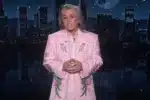
Kimmel’s guest hosts helped fill part of the void, most notably Rosie O’Donnell and Jelly Roll, who each turned their week-long stints into mini-events.
O’Donnell’s week inevitably came freighted with her decades-long feud with Trump, but while she took some much-talked-about shots at the man in the Oval Office, the bigger takeaways were the ease with which she slipped back behind the desk and viewers’ embrace of her return.
Jelly Roll came at the president more forcefully, with his Trump jokes drawing blowback from some conservative fans and prompting the country star to break format on his final night with a tearful address explaining his politics, his faith and a much-circulated photo of him with Trump.
Kimmel himself didn’t need to appear on television to remain part of the story. As the real host vacationed, YouTube played whack-a-mole with dozens of AI-generated Kimmel monologues that flooded the platform.
Meanwhile, the host who actually kept showing up was rewarded for it.
Jimmy Fallon went unusually hard on first-run episodes through much of the summer, taking advantage of the thinning field around him. For the first time in recent memory, The Tonight Show finished first among the broadcast 11:35 shows in three separate weeks when Kimmel was dark and, in early August, posted its largest weekly audience in nearly two years.
It was perhaps the simplest programming lesson of the summer: when everybody else is on vacation, being new counts for something.
Seth Meyers found his own workaround for an unusually long absence. Rather than let seven weeks pass without “A Closer Look,” he and writer-producer Sal Gentile launched A Closer Look: Out of Office, a video podcast designed specifically to cover the stories Late Night would otherwise have addressed.
The Daily Show, before beginning its own extended August break, reached a milestone that seemed improbable only a few years ago: its 30th anniversary.
Just three years ago, the franchise was teetering on the brink of cancellation following Trevor Noah’s departure, but Jon Stewart’s return and the rise of a strong correspondent bench have turned it back into one of late night’s most vital shows. LateNighter’s Bill Carter marked the anniversary with an oral history of its beginnings featuring the creative team that built it.
Awards season provided more intrigue.
The Emmys’ newly recombined Outstanding Variety Series category nominated Jimmy Kimmel Live!, The Late Show with Stephen Colbert, The Daily Show, Last Week Tonight with John Oliver, and Saturday Night Live.
Thanks to the category’s revamped yes-or-no voting system, anywhere from one to all five could theoretically win.
And Colbert’s former writers mounted one last awards push of their own. Noting that there had been no FYC campaign for the show’s writing staff, they created a campaign of their own and landed a nomination alongside Kimmel and Last Week Tonight.
That gives Colbert’s writers their best shot at breaking John Oliver’s decade-long grip on the comedy writing Emmy. (Though whether it’ll be televised remains an open question.)
John Oliver, as usual, was busy elsewhere too.
Having lobbied for a soap opera role in March, he landed two of them, appearing in outlandish guest arcs on both General Hospital and Days of Our Lives. He also waged war against overly litigious Texas travel-center chain Buc-ee’s, practically begging the company to sue him over parody merchandise.
While Paramount’s acquisition of Warner Bros. continues winding its way through the courts, Oliver seems to be taking a wait-and-see approach, signing only a one-year renewal with HBO, keeping Last Week Tonight on the air through 2027.
Saturday Night Live entered its annual summer holding pattern with at least one confirmed cast change. Chloe Fineman announced her departure after seven seasons, while the status of the rest of the ensemble remained uncertain heading into the show’s customary late-summer casting process.
The business of late night was making moves beyond the familiar franchises, too.
James Corden staged an assured return to the format with Fox’s World Cup-adjacent After Hours, a limited-run series that worked particularly well when it followed live soccer coverage.
Amazon, meanwhile, announced plans for another sports-late-night hybrid: The Stepback, hosted by former NBA star Blake Griffin.
Conan O’Brien took an even more surprising route back toward performing in front of crowds: he started a band. The former late-night host debuted The Vigodas in August, with Conan on vocals and guitar and the group’s name serving as a tribute to longtime Late Night favorite Abe Vigoda.
Bill Maher added another peculiar chapter to his relationship with Trump, accepting the Mark Twain Prize for American Humor at the Trump-controlled Kennedy Center. It later emerged that the president personally approved his selection even as he continued lobbing insults at the HBO host on social media.
Kimmel’s long-running confrontation with the administration also moved somewhere late-night fights don’t usually go: federal court.
ABC and Disney sued the FCC over its early review of the licenses of the network’s owned stations, alleging the move was retaliation for protected speech, including Kimmel’s jokes about Trump.
In sad news, Peter Lassally, the legendary late-night producer whose career stretched from Johnny Carson to David Letterman to Craig Ferguson, died in July at 93. As our Bill Carter wrote at the time, few people had a greater influence on the modern late-night talk show—or on the hosts who occupied its chairs.
Perhaps the summer’s most unexpected ratings story belonged to Byron Allen.
When CBS replaced The Late Show with Allen’s Comics Unleashed, the move was widely viewed as a dramatic comedown for a time period that had housed Letterman and Colbert for more than three decades.
But while topical competitors lost viewers in repeats, Allen’s evergreen comedy held up remarkably well. On one August night, a repeat of Comics Unleashed even topped both Kimmel and The Tonight Show in the key 18-49 demo.
For a quiet summer, that’s a lot of noise.