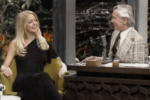
Long before Johnny Carson, Jay Leno, Conan O’Brien, or Jimmy Fallon took their turns behind the desk, the Tonight show began with Steve Allen offering viewers a warning.
“I want to give you the bad news first,” Allen told viewers on Sept. 27, 1954. “This program is going to go on forever.”
He was talking about the show’s 105-minute runtime. Seventy-two years later, the line has taken on another meaning.
NBC’s Tonight!—the program now known retroactively as Tonight Starring Steve Allen—made its network debut that night, beginning a franchise that has remained on the air ever since.
The broadcast originated live from the Hudson Theatre on West 44th Street in Manhattan, with Gene Rayburn as announcer and Skitch Henderson leading the band. Regular singers included Steve Lawrence, Eydie Gormé, Andy Williams, and Pat Marshall. Former Ink Spots lead singer Bill Kenny and New York Giants center fielder Willie Mays were among the guests. Wally Cox appeared in place of Martha Raye, who had been advertised in advance.
The first broadcast did not go entirely according to plan.
NBC had arranged for a Cadillac outfitted with a television camera to provide live pictures from Times Square. Something went wrong with the car, leaving Allen to explain what viewers were not seeing.
The unusual structure of the broadcast created more opportunities for things to go awry.
Famously, for the show’s first decade, it began 15 minutes early in some parts of the country, before the show went national at 11:30 p.m. Even then, not every station stayed for the same stretches of the show. Affiliates could join or leave at 15-minute intervals, and stations also broke away for local commercials.
Allen repeatedly had to welcome newly arrived viewers, say goodbye to departing stations, recap what some of them had missed, and fill odd amounts of airtime for those that remained.
At one point he complained that he knew “a lot of 34-second jokes” and had “a 42-second dance,” but nothing for the precise amount of time he had been handed.
“This is a confusing program tonight,” he admitted.
Much of Allen’s opening-night comedy came from those circumstances.
The premiere was not the beginning of late-night television. CBS had aired the 15-minute Faye Emerson Show beginning in 1949, while NBC had already tried network late night with Broadway Open House, which ran from 1950 to 1951.
Allen himself had been doing a local late-night show on NBC’s New York station since July 1953, first from a studio on 67th Street and later from Studio 6B at 30 Rockefeller Plaza.
NBC president Pat Weaver decided to take Allen national as part of a larger programming experiment. Weaver had already launched Today in the morning and the daytime series Home. Tonight was intended as the third piece.
Allen explained the idea during the premiere and immediately made fun of it.
“If this program is the success that the other two were,” he said, “they’re going to put out another program called Son of Tonight.”
The show was considerably looser than the late-night programs that followed. Rayburn delivered actual news reports. Singers came and went. Comedy sketches sat alongside interviews, piano numbers, audience conversations, and live remote segments.
Still, many of the pieces that would define the genre were already there: opening jokes, a band, an announcer who doubled as a comic foil, sketches, musical performances, celebrity interviews, and trips into the audience. The formal opening monologue came later.
Allen would later describe many of those elements as practical choices that gradually became convention. A piano, a newspaper item, some viewer mail, a prop, a guest or two, and an audience gave him enough material to fill a show.
Mays’ appearance happened to come at a remarkable moment in his career. He had won the National League batting title one day earlier and came on Tonight to discuss the Giants’ upcoming World Series against Cleveland. Two days later, in Game 1 at the Polo Grounds, he made the over-the-shoulder grab off Vic Wertz that became known as “The Catch.”
Only about half an hour of the premiere is readily available to watch online. (The Paley Center has more.)
That in itself is a minor miracle.
Allen’s Tonight run was almost completely lost when NBC cleared out its archive, which Allen himself would later term a “cultural atrocity.” He estimated that only about 25 of his shows survived from other sources.
Allen remained with Tonight until January 1957, with Ernie Kovacs taking over two nights a week during the latter part of his run. NBC briefly replaced the format with the newsier Tonight! America After Dark before Jack Paar arrived later that year and returned the program to comedy and conversation. Paar was followed by Carson, Leno, O’Brien, Leno again, and Fallon.
But on Sept. 27, 1954, NBC was still figuring out how a network late-night show was supposed to work, and Allen spent much of the premiere dealing with the complications in real time.
Syndicated columnist John Crosby, reviewing the first broadcast, wrote that nearly everything that could go wrong appeared to have gone wrong. Given how much Allen managed to get out of everything that got fouled up, Crosby said he hoped things stayed that way.
Eventually, he predicted, Tonight would run like clockwork.
“But it won’t be nearly so much fun.”
Get stories like this in your inbox: Sign up for LateNighter’s free daily newsletter.