


Few American politicians of the past half-century loomed as large in the late-night imagination as Dick Cheney. The former vice president, who died Monday at 84, was a singular figure—not just in Washington but in the world of political comedy, where he became shorthand for power wielded in the shadows.
During his eight years as George W. Bush’s second-in-command, Cheney occupied a role unlike any previous vice president: decisive, secretive, and unapologetically hawkish. For late-night hosts and sketch writers, that combination made him irresistible. Cheney was the stern face of post-9/11 American policy, the architect of the Iraq invasion and of expanded executive power—a man often portrayed as running the show from an undisclosed location.
His reputation as the “puppet master” of the Bush administration was amplified as much by television satire as by political journalism.
On Saturday Night Live, Cheney was played by Darrell Hammond as a smirking, dead-eyed operator—the humor coming not from bluster but from calm menace. Paired with Will Ferrell’s “frat boy” Bush, he became the disciplinarian. When Will Forte later took over as a meeker Bush, Hammond leaned further in, portraying Cheney as the one quietly steering the ship.
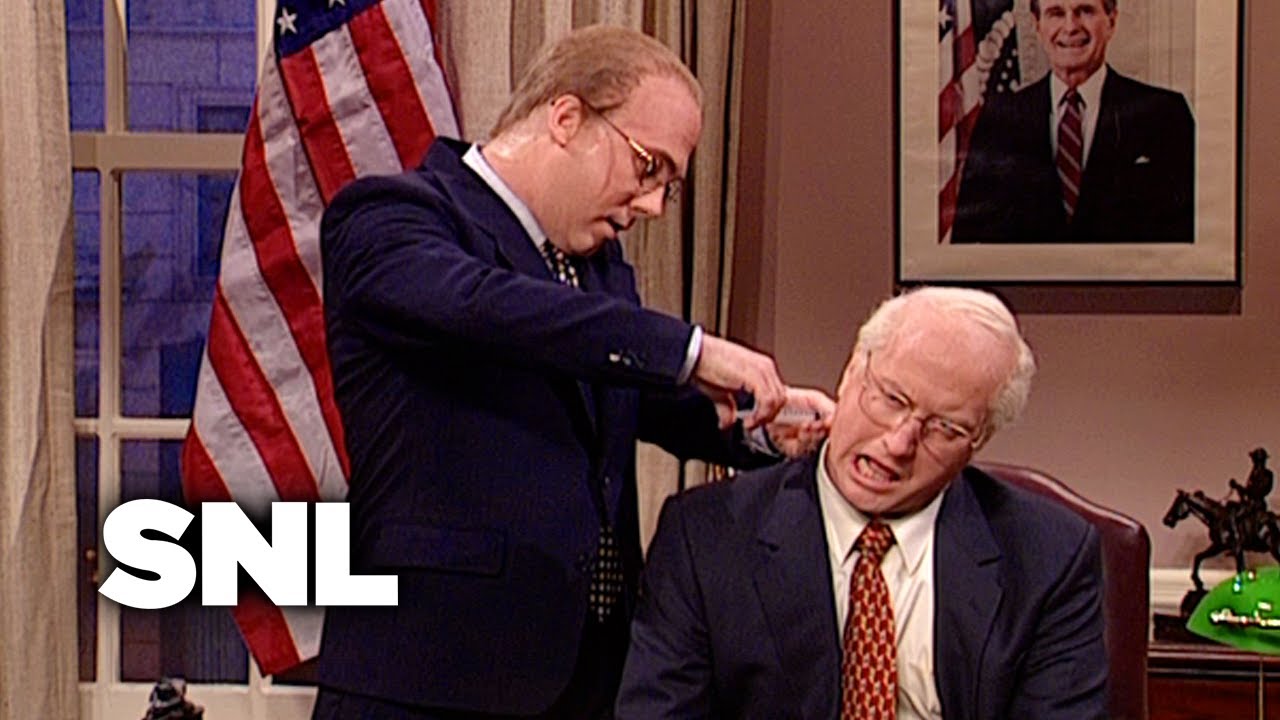
Cheney was, to late-night writers, the perfect comedy foil because he seemed allergic to charm. If Bill Clinton inspired jokes about libido and George W. Bush about naïveté, Cheney embodied something darker: the bureaucrat as Bond villain. For late-night shows, he was the personification of secrecy, the gray-suited figure who could justify anything in the name of national security.
On The Daily Show with Jon Stewart, monologues were built around clips of Cheney defending interrogation tactics or dismissing critics, cutting between the vice president’s unflappable delivery and the host’s incredulous stare. Though Bush himself was a punchline, Cheney’s presence in those years gave the comedy sharper teeth.
David Letterman’s Late Show regularly featured Top Ten Lists about Cheney’s secrecy and health scares. Jay Leno, hosting The Tonight Show, riffed on the same themes with a lighter touch, joking that Cheney’s “undisclosed location” was actually “a Motel 6 in Des Moines.” Across late night, the tone differed but the premise was shared: Cheney was the least funny man who ever made comedy look easy.
Then came the moment that sealed Cheney’s fate in the late-night canon.
On Feb. 11, 2006, while hunting quail at a Texas ranch, the vice president accidentally shot his friend and Republican donor Harry Whittington in the face with a 28-gauge shotgun.
No one was seriously hurt, but the story detonated through the media cycle. Cheney’s office initially kept the incident quiet for nearly a full day, feeding the perception of a White House allergic to transparency. When details emerged, they seemed almost too absurd to be real.
Letterman led the charge: “Good news, ladies and gentlemen—we have finally located weapons of mass destruction: It’s Dick Cheney.”
Leno followed: “With word that Cheney shot a lawyer, his popularity is now at 92 percent.”
And Jon Stewart, delivering one of The Daily Show’s sharpest segments of the era, warned viewers: “Do not let your kids go on hunting trips with the vice president. I don’t care what kind of lucrative contracts they’re trying to land, or energy regulations they’re trying to get lifted. It’s just not worth it.”
To comics, the hunting accident was more than slapstick; it was metaphor. Here was the ultimate backroom power player literally firing into his own team. Within days, “getting Cheneyed” had entered the pop-culture vocabulary.
The episode crystallized Cheney’s role in the national imagination. He was no longer just the administration’s enforcer—he was its embodiment.
Even as the tone of late night evolved—sharper, more overtly partisan—Cheney remained a touchstone. His name could still draw a laugh years after he’d left power, much as Nixon’s once did. For a generation of writers and performers, Cheney was the prototype of the political villain: intelligent, unapologetic and impervious to ridicule.
In life, Cheney’s influence divided historians and voters alike. In comedy, his legacy is far simpler. He gave late-night television its purest archetype of the era—the villain who never broke character, and never had to.
Get stories like this in your inbox: Sign up for LateNighter’s free daily newsletter.



