At the conclusion of his memoir Born Standing Up, Steve Martin writes that he sometimes can’t figure out what all the fuss over his stand-up act was about. All the fuss began in earnest 50 years ago today, when Martin hosted Saturday Night Live for the first time on Oct. 23, 1976.
At the time, both the show and Martin’s stand-up career were on the upswing. NBC’s Saturday Night, as it was then titled, entered its second season a freshly minted Emmy winner for Outstanding Comedy, Variety or Music Series. Summer reruns had earned higher ratings than the original broadcasts. People watched it at parties or rushed home to catch it. Tom Hanks later compared the show’s cultural impact to Beatlemania.
The show’s Not Ready for Prime Time Players—Dan Aykroyd, John Belushi, Chevy Chase, Jane Curtin, Garrett Morris, Laraine Newman, and Gilda Radner—were bona fide celebrities, with Chase the ensemble’s breakout star. Martin’s first episode would be Chase’s penultimate before leaving the show.
Martin was living in Aspen when he first saw NBC’s Saturday Night. “I thought, ‘They’ve done it,’” he wrote in Born Standing Up. “They did the zeitgeist, they did what we all had in our heads, this kind of new comedy. And I thought, ‘Well, someone’s done it on television now.’ I didn’t know Lorne at the time. I didn’t know anyone.”
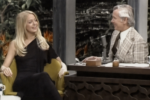
But Jean Doumanian, then the show’s talent coordinator, knew of him and advocated for him as host. “Nobody wanted to put Steve Martin on the show,” she told Lorne Michaels’ biographer Susan Morrison. “I’d seen him on The Tonight Show several times. And I kept trying to get them to let Steve do the show because I thought he was so funny. Lorne was reluctant, but when he finally [signed Steve to host], Steve’s managers sent me a dozen roses. I was just so thrilled.”
“I wanted to be on the show from the first moment I saw it,” Martin wrote in Born Standing Up. “But it was one of those timing curves where…I was not popular enough to really host it. Then there was a synchronicity in my rise to stand up and records and we sort of hit at the same moment. I was new and old fashioned at the same time and maybe the irony of my performance hadn’t reached Lorne yet… And a lot of times when the resistance finally turns to acceptance, it makes you a greater supporter of it or them.”
Martin flew to New York a few days early to get acclimated. Lorne walked him through the studio, where he met the cast. He recalled Chevy Chase playing on a piano in the corner and Aykroyd and Belushi, “one a virtuoso and one a hurricane,” entertaining each other.
Just before showtime, Martin felt “powerful butterflies” prior to being introduced, but he willed himself to be confident. “My consistent performing schedule had kept me sharp,” he wrote. “It would have been difficult to blow it.”
Martin’s monologue, adapted from his act, was a revelation, something completely different for the show. “I hadn’t seen anything quite like him,” Jim Downey, the longest-tenured writer in the show’s history, tells LateNighter. “He was absolutely the funniest person on the planet in that period. There wasn’t anyone doing silly at the time who was as smart as him.”
While Martin acted wild and crazy, he was not yet the Wild and Crazy Guy. This was Professional Show Business Steve, ready to have “some fun tonight.” He made funny faces, attempted the impossible (sucking a stool through a straw), donned his iconic arrow through the head, introduced an instant-classic catchphrase (“Well excuuuse meeee”), and, after some comical noodling, played a mean banjo (“Hey, he’s good.”)
A second monologue at the end of the show showcased what Elvis Presley once described as Martin’s “oblique sense of humor.” He concluded by saying, “We’ve had a good time tonight considering we’re all going to die.”
The audience didn’t know quite what to make of that one.
In between, he seamlessly blended with the ensemble in sketches that played to his high-energy performance style and cerebral, surreal comic worldview, most notably “Jeopardy 1999,” in which he played an unctuous futuristic game-show host, a commercial parody for a digital watchdog called Fido Flex, and “Plato’s Cave,” an extended Beatnik coffeehouse sketch in which he portrayed a poet.
Downey joined the show later in its second season and went on to become its Emmy-winning head writer. He watched Martin’s debut episode with legendary National Lampoon writer Doug Kenney, with whom he was staying at the time. His memory of the episode: “He was a sensation.”
It was an auspicious debut, but Martin’s father was apparently not impressed. “His performance did nothing to further his career,” he wrote in his newsletter for the Newport Beach Association of Realtors. But he was in the minority.
Martin discovered just how well the show had been received the following Monday, when he had a concert in Madison, Wis. He was told there were 6,000 in attendance, twice the normal crowd. “I walked onstage and was greeted with a roar of such intensity that I remember feeling both pleasure and fear,” he wrote.
This was the beginning of a beautiful symbiotic relationship. “He helped us and we helped him in terms of his rise to stardom,” Downey said.
By the time Martin returned just over four months later to host a second time, he was already considered among that rarefied breed of host who could have been a cast member. “With Steve,” Downey says, “we had incredible respect for him as a performer. He brought a much higher energy, which you could write to.”
Downey, who admits to being “kind of star struck” his first couple of years on the show, recalls that Martin involved himself in the process and “was very nice about a pitched idea. In those days, he and Lorne might circle around the offices and sit in. He had the respect of the writers and if he had any suggestions, we were all ears. I seem to remember he would go to a club [to test his monologue] the week of the show.”
Writer-performer Don Novello, best known for his classic character Father Guido Sarducci, joined the show in season three. On his very first show, Martin hosted for the fourth time. Novello looked forward to the weeks when Martin would host, he said in a phone interview, because the frantic process of putting the show together would at least be pleasant and not as nerve-wracking.
Jon Lovitz, who joined the cast in Saturday Night Live’s 11th season, was already a Martin fan long before he got to work with him. Lovitz recalls seeing Martin for the first time on The Tonight Show in the company of best friend Dave Kudrow and his family. This was before Martin hosted Saturday Night. It was Kudrow’s younger sister Lisa who told Lovitz that he “had to see this guy,” he recalls. “I was crying, laughing.”
He had a memorable meet-cute with Martin years later on the set of Three Amigos!, in which Lovitz had a small part. “I remember meeting him in the makeup trailer and he said, ‘Jon, big fan,’ and I said, ‘Me too’ and he said, ‘Of YOU?’”
By the time Martin returned for his 10th hosting stint in 1987, Lovitz was in his third season on the show. It was “thrilling,” Lovitz says, to actually work with Martin. Two years later, during Martin’s 11th hosting appearance, Lovitz wrote one of his own signature pieces, “Get to Know Me.” In it, Martin testifies, “I was a two-bit comedian with an arrow through his head” and credits getting to know Jon for his massive success: “Now I’ve just starred in movie called Parenthood directed by Opie.”
“I couldn’t believe he did it,” Lovitz says. “It was so ridiculous. It’s just insane I got to know him. Just to work with him and Bill Murray and Chevy, it was like being a part of the original cast.”
Martin is inextricably connected with Saturday Night Live. He hosted an unprecedented three times in season three. He has since hosted or co-hosted a near-record 16 times (Alec Baldwin has him beat by one at 17) and has made almost 20 cameo appearances. Not for nothing does the cover photo of Morrison’s Lorne biography feature Martin front and center with his arm around Michaels, a fitting image of their enduring creative relationship that began 50 years ago.
“It was like he was a regular,” Novello says of Martin’s appearances as host. “He was so comfortable, and everybody was comfortable with him. Whenever he hosted, everyone was so excited. Everybody loved him. It was like he was coming home.”
Get stories like this in your inbox: Sign up for LateNighter’s free daily newsletter.